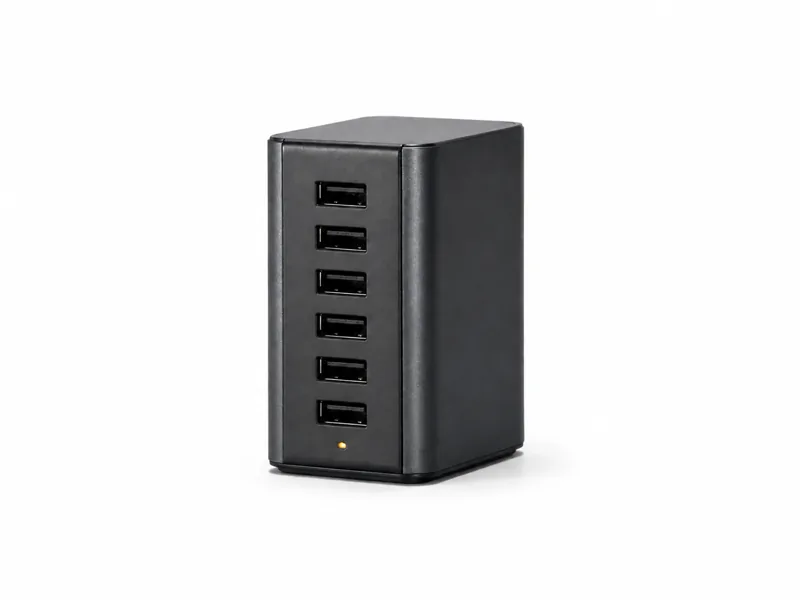
USB Security Lab Charger
A changed-up, O.MG-inspired charger demonstrator that exposes the hidden-computer risk inside ordinary USB accessories.
This supervised lab concept takes the defensive lesson of the O.MG Cable and moves it into a familiar charger-style format. An accessory that appears passive can conceal programmable electronics, USB capabilities and a wireless control path. The device is deliberately presented as a changed-up training demonstrator—not genuine O.MG hardware—so the conversation stays on accessory trust, procurement and detection rather than on copying a branded product.
Start with the device, then talk through the learning goal, authorised setup and support that make it useful.
Highlights
- O.MG-inspired concept in a changed-up charger format
- Demonstrates that familiar accessories can contain computers
- Connects USB, wireless, procurement and physical-security controls
- Designed for supervised testing on disposable lab equipment
Why the ordinary appearance matters
People inspect a laptop more carefully than a cable or charger. Accessories are borrowed, swapped, left in meeting rooms and accepted as harmless because they appear too simple to be computers. O.MG-class hardware breaks that assumption by fitting programmable electronics and a control path inside a normal-looking cable. This changed-up charger demonstrator preserves the same defensive lesson in a different form: appearance does not establish function. The device should look familiar enough to provoke the right discussion while remaining documented, labelled and controlled as active lab equipment.
What may be hidden inside an accessory
A malicious or modified accessory can contain a microcontroller, storage, a USB interface and a small radio while continuing to perform an expected everyday function. To the user it may still charge a device or resemble an ordinary data cable. To the host it may present an additional interface or generate input. The important point is not a particular concealed payload; it is that the accessory has become an active computing device. Visual inspection alone is therefore a weak control, particularly when look-alike hardware can enter through personal purchases, travel or an uncontrolled supply chain.
Where existing controls may miss the problem
Many endpoint policies focus on mass storage. That helps with flash drives but does not automatically address a device that behaves as a keyboard, serial interface, network adapter or composite peripheral. Endpoint detection may observe the processes or connections that follow without identifying the accessory itself. An embedded radio creates a second blind spot because the operator need not remain beside the target; even a facility with no conventional Wi-Fi may contain a device creating its own local control link. A useful exercise therefore connects device-class restrictions, user privilege, application control, USB logs, network telemetry, physical inspection and radio-frequency monitoring instead of expecting any one layer to solve the whole problem.
Procurement is one of the strongest controls
Known-good accessories are easier to manage than an endless attempt to identify bad ones by sight. Buy cables and chargers through approved suppliers, keep packaging and model records where risk justifies it, and prevent untracked accessories from moving into sensitive areas. Travellers and contractors should be given clear alternatives rather than a vague instruction to be careful. Data blockers and charge-only accessories can reduce exposure in the right configuration, but they must be sourced and verified too. A policy works when staff can obtain a trusted replacement quickly instead of borrowing whatever is nearby.
How to respond to a suspicious cable or charger
Do not test it on another production device. Photograph it in place, note what it was connected to and who handled it, and follow the organization’s evidence and incident-response process. Isolate affected equipment in a way that preserves relevant logs and volatile information. Security staff can then decide whether specialist USB or radio analysis is required. The exercise should rehearse that decision path so an employee is not left improvising. A suspicious accessory is both a possible endpoint event and a physical item of evidence; careless handling can destroy context or spread the problem.
Use a contained target
Run the demonstrator only with a disposable or fully recoverable lab device containing no real credentials, personal accounts or business data. Document the expected USB identities and radio behaviour before the session, limit the exercise to one clear objective and maintain a reliable way to stop it. Afterward, verify that the target is restored, account for the charger and store it separately from normal accessories. The product’s success should be measured by what the team learns and improves—not by how surprising the demonstration looks.